
In legal circles, procedural rules can sometimes spark debates that are just as fierce—and far-reaching—as the substantive rights being litigated. This was vividly demonstrated in the Supreme Court of Appeal (SCA) of South Africa’s judgment in FirstRand Limited and Another v National Bank of Abu Dhabi PJSC (Pty) Limited (Case No: 662/2024) [2026] ZASCA 98. Decided on 7 July 2026, the case did not merely resolve a high-stakes corporate trademark battle; it exposed a deep ideological rift within the SCA regarding its own power, the rule of law, and the strictness of judicial precedent.
This post explores the fascinating procedural and constitutional struggle at the heart of this judgment—focusing on when “exceptional circumstances” exist under Section 17(2)(f) of the Superior Courts Act 10 of 2013—and how the SCA’s judges clashed over the principles of horizontal stare decisis and the authority of varying bench sizes.
The Origin: What is Section 17(2)(f)?
To appreciate the gravity of the debate, one must understand the unique “safety net” provided by Section 17(2)(f). Under South African law, when a litigant is refused leave to appeal by a High Court, they may petition the SCA. Ordinarily, a decision by two SCA judges considering such a petition is final. However, Section 17(2)(f) provides an extraordinary statutory exception.
Historically, this mechanism was born out of an acknowledgment of judicial fallibility. In the landmark case of Van der Walt v Metcash Trading Co Ltd, the SCA famously issued completely contrary orders in two materially identical summary judgment cases on successive days. Section 17(2)(f) was conceptualized to ensure that such glaring contradictions or potential injustices could be corrected.
Originally, the proviso allowed the President of the SCA to refer a decision to the court for reconsideration in “exceptional circumstances”. However, the section was amended by the Judicial Matters Amendment Act 15 of 2023 (effective 3 April 2024). The amended wording provides:
“Provided that the President of the Supreme Court of Appeal may, in circumstances where a grave failure of justice would otherwise result or the administration of justice may be brought into disrepute, whether of his or her own accord or on application filed within one month of the decision, refer the decision to the court for reconsideration and, if necessary, variation.”
While the wording changed from “exceptional circumstances” to “grave failure of justice” or “bringing the administration of justice into disrepute,” the courts continue to view these statutory grounds as a highly-specialized, narrow threshold.
The Jurisprudential Rift: Who Decides the Threshold?
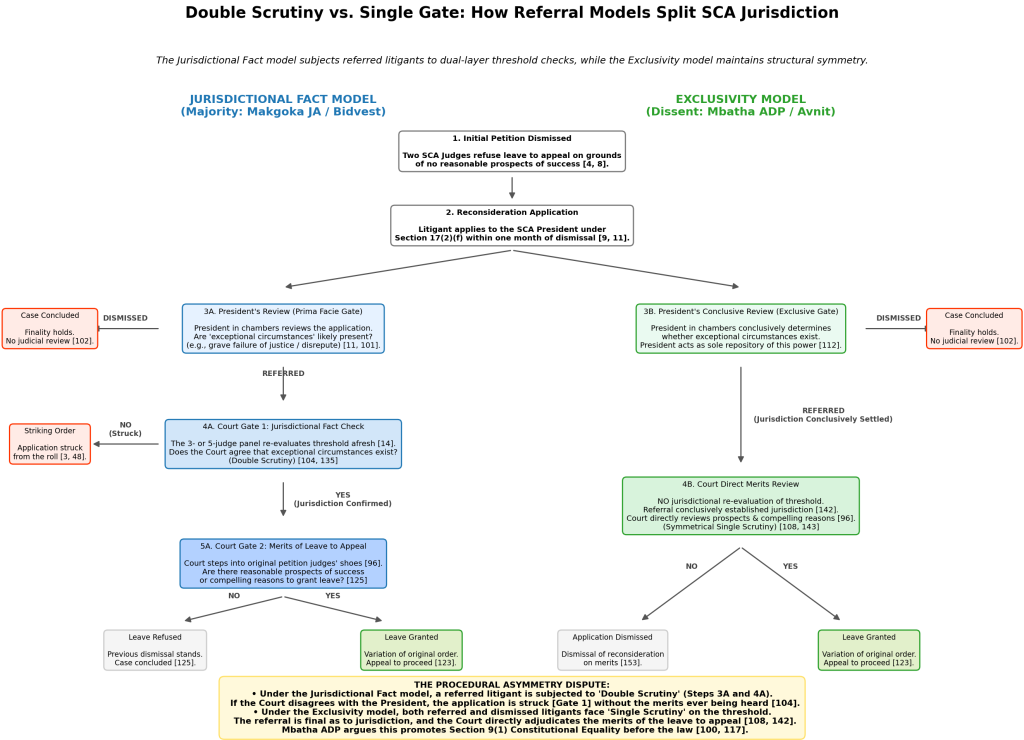
The central procedural battleground in FirstRand was a classic administrative and constitutional question: Who has the ultimate authority to decide whether the statutory threshold of “exceptional circumstances” has been met? Is it the President of the SCA (who refers the matter), or is it the court panel that ultimately hears the case?
This question divided the five-judge bench into two distinct camps:
1. The Jurisdictional Fact Interpretation (The Majority)
The majority judgment, penned by Makgoka JA (with Schippers, Hughes, and Unterhalter JJA concurring), firmly aligned with the court’s recent line of jurisprudence anchored in Motsoeneng v South African Broadcasting Corporation and Bidvest Protea Coin Security v Mabena.
According to this school of thought:
- The President’s role is preliminary: The President makes a prima facie determination that there is a likelihood of grave failure of justice or disrepute, which justifies referring the matter.
- The Court makes the final call: The court panel to which the matter is referred must determine on a conclusive basis whether the jurisdictional facts (i.e., exceptional circumstances) are actually present.
- Jurisdictional Bar: If the court finds that no such circumstances exist, it lacks jurisdiction to reconsider the petition and must strike the application from the roll. It cannot simply go on to decide the merits of the appeal.
The majority justified this by noting that when the President considers an application in chambers, she or he does not have the benefit of the full record of proceedings or oral arguments. The court panel, having analyzed the full record and heard oral submissions, is in a far better position to make a final, substantive determination.
2. The Exclusivity Interpretation (The Dissent)
Mbatha ADP penned a vigorous dissenting judgment, arguing that the majority’s approach is both statutorily and constitutionally flawed. Endorsing the earlier approach in Avnit v First Rand Bank and the minority views in S v Godloza and Schoeman v Director of Public Prosecutions, the dissent maintained:
- Exclusive presidential power: The statutory power to assess and decide whether exceptional circumstances exist belongs exclusively and finally to the President.
- The “Post-Box” Fallacy: To argue that the court must re-evaluate the President’s referral is to treat the President as a mere “administrative postbox” or “halfway-house,” which strips the office of its substantive judicial functions under the Act.
- Strict separation of inquiry: Once the President refers the matter, the court “steps into the shoes” of the two judges who originally refused leave. The court’s only task is to determine the merits of the leave to appeal (i.e., reasonable prospects of success or compelling reasons under Section 17(1)(a)). It has no business re-litigating whether the referral itself was justified.
- Constitutional Asymmetry: The dissent highlighted a severe inequality under Section 9(1) of the Constitution (equality before the law). If the President dismisses a Section 17(2)(f) petition in chambers, that decision is final and subject to no further judicial review. However, if the President grants the referral, the litigant is subjected to a “double scrutiny” where the court panel can overturn the referral. Identically situated litigants are thus treated with structural inequality.
The Precedent Battle: Can a 3-Judge Bench Overrule a 5-Judge Bench?
Beyond the interpretation of Section 17(2)(f), FirstRand exposed a fascinating institutional struggle over horizontal stare decisis—the principle that a court is bound by its own prior decisions.
The procedural history on this topic is remarkably turbulent. In 2024 and 2025, five-judge benches in Motsoeneng and Bidvest established the “jurisdictional fact” model. However, subsequent three-judge panels in 4 Seasons Logistics CC v Kgotse, Matsi v South African Legal Practice Council, and Lutzkie v Commissioner for SARS rebelled. The three-judge panel in 4 Seasons went so far as to declare Motsoeneng and Bidvest “clearly wrong” and refused to follow them.
In the FirstRand judgment, the Majority and Minority clashed sharply over whether these three-judge panels acted competently:
- The Majority’s Hierarchy (The Larger Bench Rule): Makgoka JA, relying on the recent five-judge decision in Luphondo v The State, re-affirmed that while all properly constituted benches of the SCA carry equal authority, a smaller bench (3 judges) cannot competently overrule a larger bench (5 judges). If a conflict arises, the binding authority is always that of the larger bench. Makgoka JA warned that allowing three-judge panels to easily toss out five-judge precedents creates “intolerable legal uncertainty” and makes judicial outcomes depend entirely on “who happened to be sitting” on a given day.
- The Dissent’s Equality (The “One Court” Rule): Mbatha ADP strongly rejected this hierarchical view of the SCA. Citing Section 13 of the Superior Courts Act and foreign authorities such as the English Court of Appeal in Young v Bristol Aeroplane Company and Williams v Fawcett, the dissent argued that the SCA is “one court”. The President’s power to constitute three-, five-, or seven-judge panels is a matter of administrative convenience and expediency, not of judicial hierarchy. Therefore, a three-judge panel is fully competent to depart from a five-judge precedent if it is convinced the prior decision was “clearly wrong” or incompatible with constitutional values.
Case Study: FirstRand v National Bank of Abu Dhabi on the Merits
While the judges fiercely debated these procedural and constitutional questions, they were remarkably unified on the underlying commercial and trademark merits of the case.
The Facts
The respondent, the National Bank of Abu Dhabi (a massive lender operating in 20 countries across five continents), applied in South Africa to register the trademarks “FIRST ABU DHABI BANK” and “GROW STRONGER FIRST ABU DHABI BANK” in class 36 for financial and banking services.
FirstRand, the prominent South African commercial banking group, opposed these applications under Section 10(4) of the Trade Marks Act 194 of 1993. This section prohibits the registration of a mark if the applicant has “no bona fide intention of using it as a trademark”. FirstRand argued that Abu Dhabi Bank could not have a bona fide intention to use the mark because it did not hold a South African banking licence or authorization from the Financial Services Board (FSB).
The High Court’s Missteps
The High Court dismissed FirstRand’s opposition but made two glaring errors of law:
1. On the Merits: It conflated Section 10(4) (intention to use) with Section 10(14) (confusing similarity and trademark infringement).
2. On the Onus: It incorrectly stated that the opponent (FirstRand) bore the onus of proving the applicant’s lack of bona fide intention. (In opposition proceedings, the onus rests squarely on the applicant for registration to satisfy the court that there is no bar to registration).
The SCA’s Resolution
Both the Majority and Minority of the SCA agreed that despite the High Court’s errors, the substantive result was correct:
- Erroneous Onus was per incuriam: The High Court’s misstatement of the law was a mere slip (per incuriam) and did not create a binding or dangerous precedent.
- Commercial Reasonableness: Applying the classic Plascon-Evans rule, the SCA accepted Abu Dhabi Bank’s explanation as “objectively sound”. The bank explained that its strategy was to secure its trademark rights before incurring the massive financial risks and costs of applying for a local banking licence.
- No Ulterior Motive: There is no law requiring an applicant to hold a banking licence at the time of trademark registration. Once registered, the bank has five years under Section 36 of the Act to commence trading. It was highly implausible that an international institution of such stature would expend resources on trademark registration without a genuine intent to eventually do business.
Consequently, there were no “exceptional circumstances” or “grave failures of justice” that would justify reversing the refusal of leave to appeal.
Takeaways for Legal Practitioners and Businesses
For corporate counsel, intellectual property practitioners, and business leaders, the FirstRand judgment provides invaluable guidance:
1. Section 17(2)(f) remains an exceptionally high bar: A mere error of law or a “difference of opinion” regarding a lower court’s reasoning does not meet the threshold of a “grave failure of justice” or “bringing the administration of justice into disrepute”. Reconsideration is a narrow “safety valve” reserved for truly extraordinary circumstances.
2. Sequential trademark strategy is legally valid: International businesses looking to expand into South Africa do not need to obtain regulatory licences (such as banking, financial services, or other restricted sector licences) before filing for trademark protection. Securing intellectual property as a strategic “first step” to mitigate financial risk is a legally recognized, bona fide business practice.
3. The Precedent War continues: Until an enlarged panel of seven, nine, or eleven judges is convened under Section 13(1)(b) to decisively resolve the repository of power under Section 17(2)(f), litigants must be prepared for rigorous double-scrutiny when applying for reconsideration. For now, the five-judge majority decisions in Motsoeneng, Bidvest, and Luphondo remain the binding standard, but the intellectual and constitutional battle lines are clearly drawn.
Get in touch with the Crawford Harris Inc team for professional legal guidance in your appeal matter.
References Considered
1. ABSA Bank Ltd v Mkhize and Two Similar Cases [2013] ZASCA 139; 2014 (5) SA 16 (SCA)
2. Albutt v Centre for the Study of Violence and Reconciliation [2010] ZACC 4; 2010 (3) SA 293 (CC); 2010 (5) BCLR 391 (CC)
3. Avnit v First Rand Bank Ltd [2014] ZASCA 132
4. Bato Star Fishing (Pty) Ltd v Minister of Environmental Affairs and Tourism and Others [2004] ZACC 15; 2004 (4) SA 490 (CC); 2004 (7) BCLR 687 (CC)
5. Bidvest Protea Coin Security (Pty) Ltd v Mabena [2025] ZASCA 23; 2025 (3) SA 362 (SCA)
6. Bliss Brands (Pty) Ltd v Advertising Regulatory Board NPC and Others [2023] ZACC 19; 2023 (10) BCLR 1153 (CC)
7. Bloemfontein Town Council v Richter 1938 AD 195
8. Cipla Medpro (Pty) Ltd v Aventis Pharma SA and Related Appeal [2012] ZASCA 108; 2013 (4) SA 579 (SCA)
9. Etraction (Pty) Ltd v Tyrecor (Pty) Ltd [2015] ZASCA 78; 2015 BIP 253 (SCA)
10. FirstRand Limited and Another v National Bank of Abu Dhabi PJSC (Pty) Limited (662/2024) [2026] ZASCA 98 (7 July 2026)
11. Fisher v Silverbirch Estate Homeowners’ Association (NPC) and Others [2026] ZASCA 69
12. Fischer and Another v Ramahlele and Others [2014] ZASCA 88; 2014 (4) SA 614 (SCA); [2014] 3 All SA 395 (SCA)
13. 4 Seasons Logistics CC v Kgotse [2026] ZASCA 9; [2026] 1 All SA 415
14. Groot Constantia Trust v DGB (Proprietary) Limited [2015] ZAGPPHC 1086; 2015 JDR 2039 (GP); 2015 BIP 330 (GP)
15. Holeni v Land and Agricultural Development Bank of South Africa [2009] ZASCA 9; 2009 (4) SA 437 (SCA); [2009] 3 All SA 22
16. Hough v Sisilana [2018] ZASCA 4; 2018 JDR 1283 (SCA)
17. In re Ducker’s Trade Mark [1929] 1 Ch 113 (CA) ([1928] 45 RPC 105)
18. In the Matter of an Application by Rosaleen Dalton for Judicial Review [2023] UKSC 36; [2023] 3 WLR 671
19. Investigating Directorate: Serious Economic Offences and Others v Hyundai Motor Distributors (Pty) Ltd and Others [2000] ZACC 12; 2001 (1) SA 545 (CC); 2000 (2) SACR 349 (CC); 2000 (10) BCLR 1079 (CC)
20. Lekeka v S [2025] ZASCA 182
21. Lidl Great Britain Ltd and Lidl Stiftung & Co. KG v Tesco Stores Limited and Tesco PLC [2024] EWCA Civ 262
22. Luphondo v The State [2026] ZASCA 24; 2026 (1) SACR 613 (SCA); [2026] 2 All SA 238 (SCA)
23. Lutzkie v Commissioner for the South African Revenue Service [2026] ZASCA 11; 2026 JDR 0648
24. Matsi and Another v The South African Legal Practice Council (Gauteng Province) [2026] ZASCA 12; 2026 JDR 0649 (SCA)
25. Minister of Police and Another v Ramabanta [2025] ZASCA 95; 2026 (1) SA 100 (SCA)
26. Motsoeneng v South African Broadcasting Corporation Soc Ltd and Others [2024] ZASCA 80; 2025 (4) SA 122 (SCA)
27. National Brands Ltd v Cape Cookies CC and Another [2023] ZASCA 93; 2024 (2) SA 296 (SCA); [2023] 3 All SA 363 (SCA); 2023 BIP 7 (SCA)
28. National Director of Public Prosecutions v Zuma 2009 (2) SCA 277 (SCA); 2009(1) SACR 361 (SCA); 2009 (4) BCLR 393 (SCA); [2009] 2 All SA 243
29. Nel v S [2025] ZASCA 89
30. Patmar Explorations (Pty) Ltd and Others v Limpopo Development Tribunal and Others [2018] ZASCA 19; 2018 (4) SA 107 (SCA)
31. Plascon-Evans Paints Ltd v Van Riebeeck Paints (Pty) Ltd 1984 (3) SA 623 (A); [1984] 2 All SA 366 (A)
32. Potgieter v Potgieter NO [2011] ZASCA 181; 2012 (1) 637 (SCA)
33. Pretoria City Council v Levinson 1949 (3) SA 305 (A)
34. Road Accident Fund v Lewis [2025] ZASCA 174; [2026] 1 All SA 70 (SCA)
35. S v Godloza and Another [2025] ZACC 24; 2026 JDR 0431 (CC)
36. S v Gwababa [2018] ZASCA 152; 2018 JDR 1951 (SCA)
37. S v Liesching and Others [2018] ZACC 25; 2019 (1) SACR 178 (CC); 2019 (4) SA 219 (CC); 2018 (11) BCLR 1349 (CC)
38. S v Malele [2016] ZASCA 115; 2016 JDR 1686 (SCA)
39. S v Mathekola [2017] ZASCA 100; 2017 JDR 1414 (SCA)
40. S v Ntlanyeni [2016] ZASCA; 2016 (1) SACR 581 (SCA)
41. Schoeman v Director of Public Prosecutions 2025 (2) SACR 561 (SCA)
42. Seebed CC t/a Siyabonga Convenience Centre v Engen Petroleum Ltd [2022] ZACC 28; 2023 (12) BCLR 1535 (CC)
43. True Motives 84 (Pty) Ltd v Mahdi and Another [2009] ZASCA 4; 2009 (4) SA 153 (SCA)
44. Van der Walt v Metcash Trading Limited [2002] ZACC 4; 2002 (4) SA 317; 2002 (5) BCLR 454 (CC)
45. Veldman v Director of Public Prosecutions, Witwatersrand Local Division 2007 (3) SA 210 (CC)
46. Victoria’s Secrets Inc v Edgars Stores Ltd 1994 (3) SA 739 (A); [1994] 4 All SA 307 (A)
47. Western Johannesburg Rent Board and Another v Ursula Mansions (Pty) Ltd 1948 (3) SA 353 (A)
48. Williams v Fawcett [1985] 1 All ER 787
49. Young v Bristol Aeroplane Company, Limited [1944] 1 KB 718
IMPORTANT: The information provided in this article is for general informational purposes only and does not constitute legal advice. Reading this content does not create an attorney-client relationship between you and Crawford Harris Inc. Laws vary by jurisdiction and change over time, and the application of the law to your specific situation may differ from what is discussed here. You should not act or rely on any information in this article without seeking the advice of a qualified attorney in your jurisdiction. Crawford Harris Inc expressly disclaims all liability for actions taken or not taken based on the contents of this article.